Field Note
The Frayed Rope
Field Note
There's an exhibition called Body Worlds — real human bodies, preserved, every layer of tissue exposed.
It traveled through the country years ago, and I was fascinated by all of it.
A gymnast. A bodybuilder. A ballerina. An archer. A skateboarder. A mother. A smoker's lungs beside a non-smoker's.
I studied the bodybuilder for a long time.
The muscle was enormous. Impressive, the way it's supposed to be. But looking closely, something was strange about it — the fibers looked frayed. Like a rope pulled apart at the ends, each thread separating from the next.
The dancer was something else entirely — dramatic, stunning, captured mid-jump or mid-spin, full-body coordination frozen in a single moment.
I've thought about both of them for years.
Big muscle isn't the same thing as strong muscle. A muscle trained in isolation — worked hard alone, without training its relationship to the bone beneath it, the fascia around it, the nervous system directing it — can still grow strong. But tendons and connective tissue adapt slower than muscle does. Isolated training creates a mismatch — the muscle strengthening faster than the tendons and fascia around it can keep pace with. That mismatch is the actual vulnerability.
And dramatic flexibility isn't automatically health, either. A lot of what makes a dancer's body so striking comes from genuine hypermobility — joints allowed to move further than most bodies can safely control. It's beautiful to watch. It's also why so many dancers' careers end early, and why their joints often pay for it later. Flexibility at the expense of structural integrity isn't the same thing as health. Sometimes it's closer to contortionism wearing health's clothes.
Neither extreme is really about health. It's out of balance, versus coming home to your original blueprint — strong and coordinated the way a child's body is, everything working together, nothing yet pulled toward one extreme.
Most bodies drift toward an extreme anyway. Over-strong, under-flexible. Or over-flexible, under-strong. Alignment is finding the balance between strength and flexibility, whichever side of that spectrum you've landed on.
Part of why it can be done well into old age.
I didn't just see this in a museum.
I lived it, standing next to a football player in my mother's university class.
I was demonstrating for her. He was a student — huge, much stronger than almost everyone in the room besides his own teammates. Next to him, I looked small.
We came into handstand at the same time. We were aiming for a long hold.
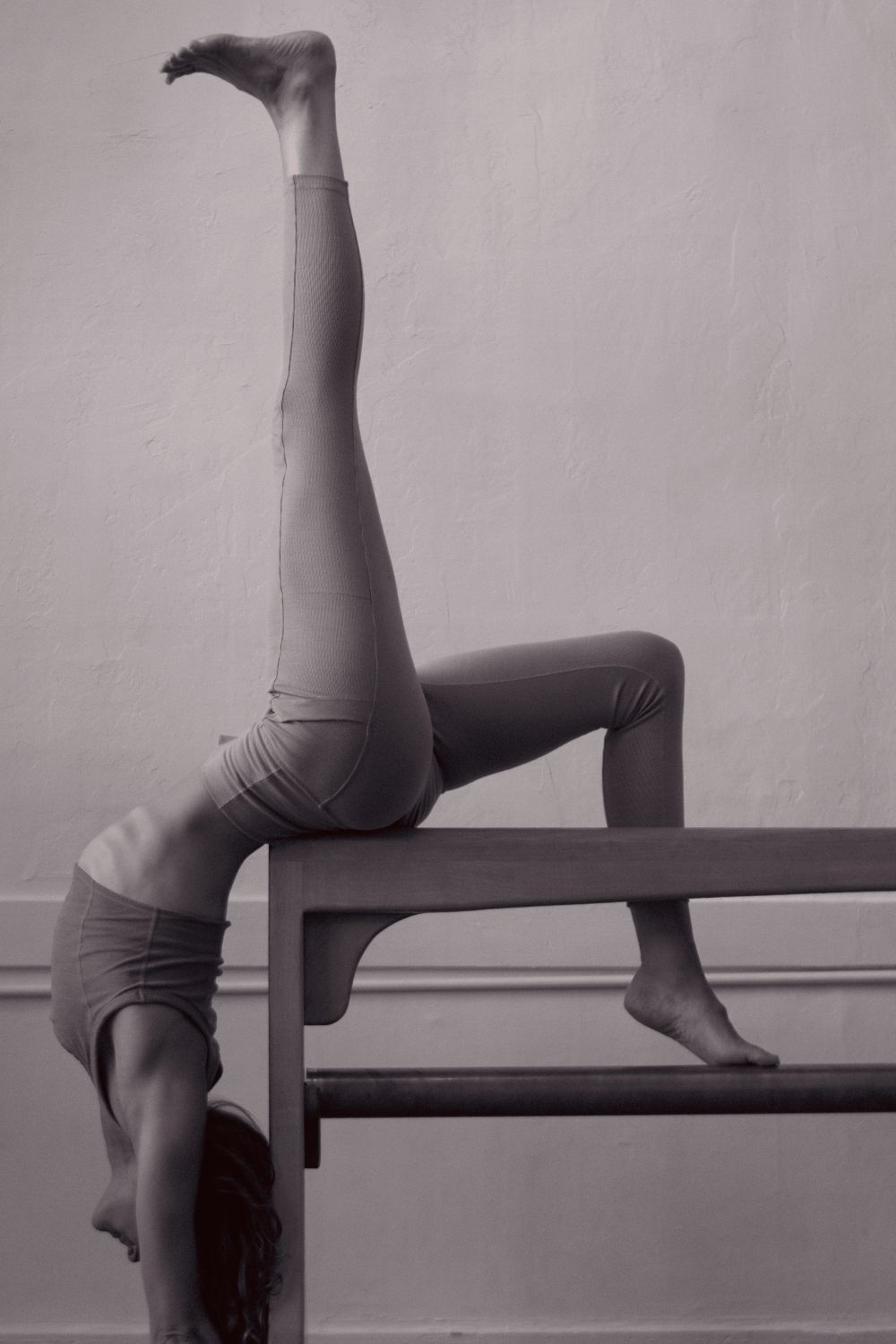
Mine wasn't easy. Every handstand asks something real of you. But my wrists were stacked under my elbows, my elbows under my shoulders, my whole body organized and coordinated into one aligned line — and from the outside, it looked effortless.
His didn't.
He muscled through it. Beads of sweat forming on his forehead. Straining against his own strength instead of organizing it. He came down before I did. He had to.
More muscle in that room. Less articulation through the whole body.
I don't think most people ever get shown the difference. Bigger reads as stronger. More flexible reads as healthier. Neither is always true.
It's not just structure. It's full-body coordination, articulation — every part in relationship with every other part, instead of straining alone.
That's what actually lasts.
Get New Field Notes
A quiet note in your inbox, whenever a new one is written. Nothing else.